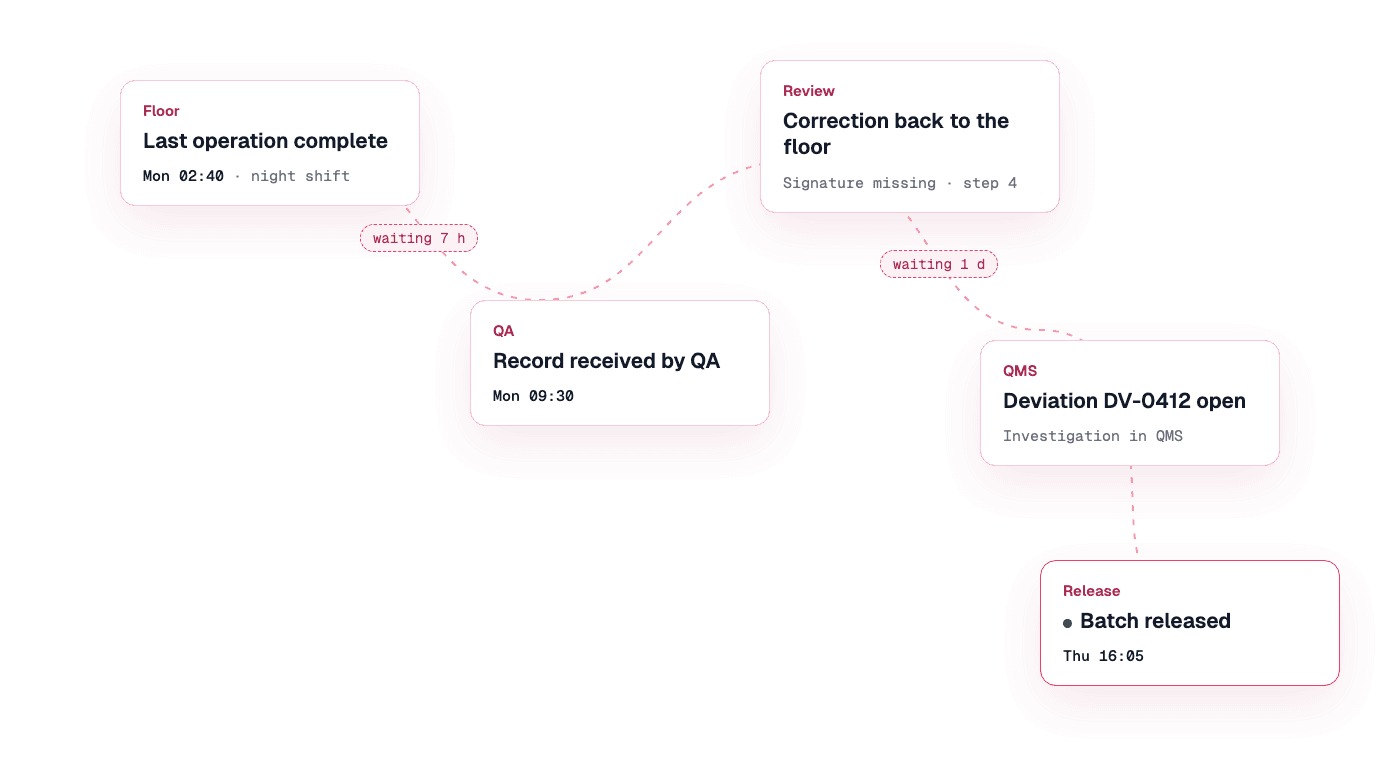
Ask a head of quality how long it takes to release a batch after the last operation ends, and you get a number. Ask where those days go, and the answer takes longer.
The product sits in quarantine the whole time. Your warehouse holds it, your planners work around it, and your customer waits for it. Yet few plants can say how much of that time people spend working on the batch and how much the batch spends waiting for someone.
Six stops account for most of it.
1. The record travels to QA
On a paper or hybrid site, the batch record has to leave the floor, get checked by a supervisor, and reach a reviewer. If the batch ends on a night shift, the record often sits until the morning. If one section is still open, the whole record waits for it.
You can lose a day here before anyone in QA has opened the folder.
2. Review finds the same small errors
Reviewers read every page because they have to. Most of what they find are good documentation errors: a missing signature, a value without a unit, an entry made outside its time window, a correction without a reason.
None of these change the product. Each one still stops the review.
3. Corrections go back to the floor
A reviewer can't fix an operator's entry. The record goes back to the person who made it, and that person may be on another shift, on leave, or at another line. The reviewer moves on to the next batch, then has to pick this one up again when it returns.
A single missing signature can cost two days this way.
4. QC results arrive on their own schedule
Testing has its own queue. Release can't start until the lab has approved results, and an out-of-specification result opens an investigation of its own. Your batch record team may finish review and then wait on the lab, or the lab may finish first and wait on review. In both cases one of the two sits idle against the batch.
5. Open deviations hold the batch
You can't release a batch with an open deviation against it. The investigator pulls data from MES, LIMS, the QMS, and paper logs, then writes the report and routes it for approval. When the deviation was logged late, or logged without the batch data attached, the investigation starts from scratch.
6. Someone assembles the release packet
Before the final sign-off, someone prints or exports the executed record, the certificates of analysis, the deviation closures, and the ERP status, then puts them in one place. People re-key values from one system into another to make the packet agree with itself. Then the packet waits for the person who signs, who has other batches in the queue.
Measure it at your own plant
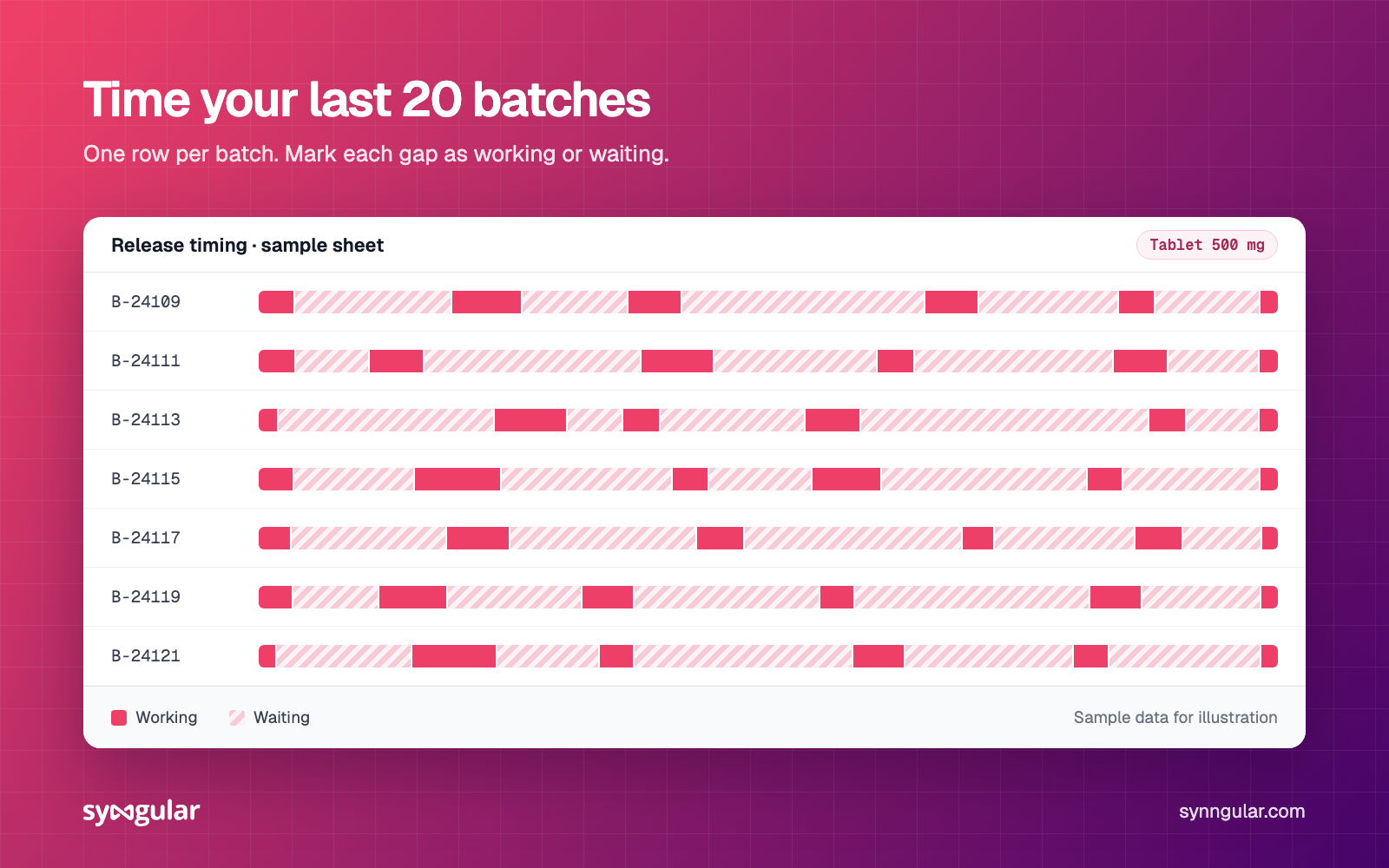
You don't need a project to find your own numbers. Take your last 20 released batches and fill in one row per batch:
| Timestamp | Where to find it |
|---|---|
| Last operation completed | Batch record or MES |
| Record received by QA | QA log or handover sheet |
| First review complete | Reviewer's signature |
| Corrections closed | Last correction date |
| QC results approved | LIMS |
| Deviations closed | QMS |
| Release packet complete | QA log |
| Batch released | ERP status change |
Then mark each gap as working time or waiting time. Compare the time your reviewers spend reading with the time the batch spends between steps: the record waiting for a reviewer, the correction waiting for an operator, the packet waiting for a signer.
If the waits are larger, another reviewer won't help much. A new hire shortens the review and leaves the waits on either side of it.
What shortens the waits
Four changes go after the waits:
- Catch errors at entry. If the system checks the value, unit, and range when the operator records it, the error never reaches review.
- Review by exception. Reviewers look at what fell outside its limits or changed after entry, not every line.
- Log deviations against the record. The investigator starts with the batch data already attached.
- Report readiness every morning. QA leads see which batches are waiting and on what, before anyone has to chase.
These are the workflows we built Synngular around. You can see how batch record review and release works on the platform.
If you run the 20-batch exercise and want a second pair of eyes on the result, send it to us. We will tell you where we think your days are going.